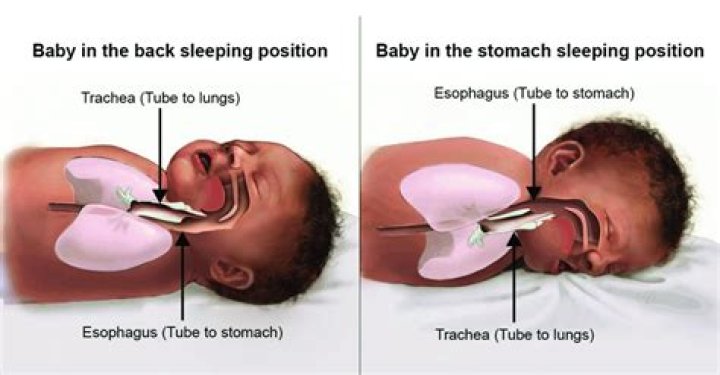
Your baby should not sleep on their stomach until they're one year old. They should always be placed on their back to sleep during the first 12 months to ensure a safe sleeping position.
Is it OK for baby to sleep on tummy?
For a baby in her first year of life, back-sleeping is the recommended safe sleeping position. Sleeping on the stomach is an unsafe sleeping position because it can increase the risk of Sudden Infant Death Syndrome (SIDS).What age can you lay a baby on their stomach to sleep?
You should always put your baby to bed on her back until she's 12 months old, even if she ends up rolling onto her stomach at night. Doing so sharply reduces the risk of SIDS — which is one of the leading causes of death during a baby's first year of life, especially within the first 4 to 6 months.What age can babies sleep on their stomach NHS?
It isn't safe to put babies to sleep on their stomach at least until the age of 1 year old, because this position increases the risk of SIDS.Why do babies sleep better on tummy?
The American Academy of Pediatrics (AAP) urges parents to put their babies "back to sleep" in order to avoid Sudden Infant Death Syndrome (SIDS). But here's the truth: babies do sleep better on their bellies. “Sleep is likely to be deeper and easier to initiate when lying in the prone (on the front) position,” Dr.My son sleeps better on his side or tummy, but I'm scared of SIDS. What can I do?
Can I let my 1 month old sleep on his stomach?
Like we mentioned, the guidelines recommend you continue to put your baby to sleep on their back until age 1, even though around 6 months old — or even earlier — they'll be able to roll over both ways naturally. Once this happens, it's generally OK to let your little one sleep in this position.Does stomach sleeping increase SIDS rate?
The single most effective action that parents and caregivers can take to lower a baby's risk of SIDS is to place the baby to sleep on his or her back for naps and at night. Compared with back sleeping, stomach sleeping increases the risk of SIDS by 1.7 - 12.9.Is it OK if my baby rolls over in his sleep?
But it's OK for infants to sleep on their stomach or side once they're able to flip themselves over to that position themselves. So if your child is able to flip onto their stomach and seems to enjoy sleeping that way, you can let them continue sleeping in that position. We're here for you.When should I stop holding my baby to sleep?
“It's always okay to hold an infant under four months old, to put them to sleep the way they need it,” says Satya Narisety, MD, assistant professor in the department of pediatrics at Rutgers University. Always put him or her on his or her back on a flat mattress in the crib or bassinet after he or she falls asleep.When do you stop using sleep sacks?
When baby's reach this limit will vary—some might get there as early as 18 months and others not till 2 years old. Regardless, if the largest sleep sack no longer fits, it's time to consider a transition out of the sleep sack. Your baby's comfort level with the sleep sack will also play a role in how long they wear it.Can baby sleep on my chest if I'm awake?
It's safe for your baby to nap on your chest as long as you remain awake and aware of the baby. But if you fall asleep too, it raises the risk of injury (or death) to your baby.What is the oldest SIDS death?
The study population was aged 2 weeks through 2 years of age; 16 deaths occurred among toddlers between the ages of 52 and 103 weeks, that were classified as “definitely” or “probably” SIDS (the investigators used 103 weeks as the upper age limit for SIDS deaths).Which is at the highest risk of SIDS?
The peak incidence of SIDS occurs between 1 – 4 months of age; 90% of cases occur before 6 months of age. Babies continue to be at risk for SIDS up to 12 months.What are 5 possible causes of SIDS?
Risk factors
- Sex. Boys are slightly more likely to die of SIDS .
- Age. Infants are most vulnerable between the second and fourth months of life.
- Race. For reasons that aren't well-understood, nonwhite infants are more likely to develop SIDS .
- Family history. ...
- Secondhand smoke. ...
- Being premature.